
Hiking Near Puerto Viejo: Best Trails on Costa Rica's Caribbean Coast
The Gandoca-Manzanillo Wildlife Refuge starts 13 km south of Puerto Viejo and runs to the Panamanian border—flat coastal jungle trail, howler monkeys overhead, Caribbean 50 meters to your right. Cahuita National Park is 30 minutes north, 8 km of flat trail along a coral reef with sloths and caimans. No permits, no gear requirements for either. This guide covers the four main hiking options near Puerto Viejo, with exact distances, what you'll encounter, and which ones require a guide.
Quick comparison
| Trail | Distance | Difficulty | Highlights |
|---|---|---|---|
| Manzanillo coastal trail | 2–5 km | Easy | Howler monkeys, Caribbean views |
| Cahuita National Park | 8 km round trip | Easy–Moderate | Coral reef, sloths, wildlife |
| Kekoldi Hawk Watch | 0.5–1 km | Moderate | Observation tower, vistas |
| Waterfall hikes | Varies (2–5 km) | Moderate–Hard | Swimming holes, jungle immersion |
Gandoca-Manzanillo coastal trail — most accessible
This is the right first hike for anyone based in Puerto Viejo. The trail starts in the village of Manzanillo—about 20 minutes by taxi or 45 minutes by bike along the coast road—and follows the Caribbean shoreline south through primary jungle for 4–5 km one way. It's completely flat, there's no entrance fee, and you don't need a guide. Howler monkeys, red-eyed tree frogs, white-faced capuchins, and dozens of bird species are regular sightings within the first kilometer. Go early—wildlife activity drops sharply once the heat builds.
- Best for: All fitness levels, including families with children and anyone not looking for a strenuous workout. This is accessible jungle, not a technical trail.
- When to go: 7–8 am start is ideal—cooler temperatures and the highest wildlife activity of the day. By 10 am the heat is significant and animals go quiet.
- What to bring: Water shoes or closed sandals (the trail has rocky and muddy sections), 2–3 liters of water per person, insect repellent, snacks. No stores once you leave Manzanillo village.
- Turn-around point: Walk 2 km for a quick out-and-back, or push to Punta Mona (4–5 km) for a full morning. Gandoca beach at the far end takes the better part of a day.
- Parking: Free parking near Manzanillo village. Don't leave valuables in the car.
- Local guide: Optional but genuinely worthwhile—a good guide doubles the number of animals you see by knowing where to look. Operators in Manzanillo and Puerto Viejo town charge $20–40 USD per person.
Cahuita National Park trail — flat, easy, and wildlife-rich
Cahuita National Park sits about 30 minutes north of Puerto Viejo and offers 8 km of round-trip coastal trail that follows a fringing coral reef through primary jungle. The terrain is flat throughout. White-faced capuchin monkeys drop through the canopy overhead, three-toed sloths hang in the cecropia trees beside the path, caimans idle in river shallows, and the beach on your right is deserted. Unlike Tortuguero, which draws tour buses and organized groups, Cahuita still feels quiet and local. You can enter the Kelly Creek station for free—a donation of $5–10 USD is appropriate.
- Best for: Wildlife photography, combining with a snorkel session at the reef, and anyone wanting a full-day outing with no strenuous effort.
- Time: Allow 3–4 hours for the full 8 km round trip at a relaxed pace with wildlife stops. A 2–3 km out-and-back from Kelly Creek takes about 1.5 hours and still delivers excellent wildlife.
- River crossing: The trail starts with a knee-deep river crossing at Kelly Creek—wear water shoes. After heavy rain the crossing can deepen; ask rangers before you set out if there's been significant rain overnight.
- Entry: Free entry by donation at Kelly Creek (Cahuita village end). Paid entry ($5–10 USD) at Puerto Vargas station, 5 km south of town.
- Facilities: Very limited—a small ranger station and basic restrooms at each entrance. Bring 2–3 liters of water, sunscreen, and snacks. Nothing is available on the trail.
Kekoldi Hawk Watch Watchtower — short and steep
Kekoldi is different from the other hikes here. It's short—only 0.5–1 km—but steep enough to leave you breathing hard. The trail climbs through indigenous Bribri territory to a wooden observation tower used by researchers to count hawk migration. In October and November, up to 3 million raptors pass through this narrow land corridor on their way south—turkey vultures, Swainson's hawks, Mississippi kites, and broad-winged hawks filling the sky in visible columns. The view from the tower over the jungle canopy and Caribbean coast is one of the better vistas accessible from Puerto Viejo. A guide is required—this is private indigenous land and you cannot simply walk in.
- Best for: Bird watchers, hikers who want elevation and views, and anyone interested in indigenous Bribri culture alongside the natural experience.
- Peak season for hawks: Mid-October through mid-November. Outside this window the hike is still worthwhile for views and resident birds, but the mass migration spectacle won't be there.
- Guide required: Contact ATEC (Asociación Talamanca de Ecoturismo y Conservación) at their office in Puerto Viejo town. They coordinate access and provide certified guides.
- Cost: Typically $40–60 USD per person covering guide, entry, and cultural interpretation.
- Time: Plan 2–3 hours total, including the uphill approach, tower time, and descent.
Waterfall hikes — guided jungle immersion
Several waterfalls in the mountains directly behind Puerto Viejo feed into natural swimming holes that don't appear on any public map. The trails to reach them are unmarked, change seasonally, and pass through private land and thick jungle—realistically impossible to find without a guide who knows the route. What you get: 3–4 hours of proper jungle hiking with river crossings, steep muddy sections, and swimming in cold, clear pools under 10–15 meter cascades. It's the most physically demanding option on this list and the most immersive.
- Best for: Swimmers, anyone who wants to actually get into the jungle rather than walk along its edge, and photographers who want something beyond the standard wildlife shots.
- Difficulty: Moderate to hard. Expect mud, multiple stream crossings, some scrambling on roots, and significant humidity. Fitness matters here.
- Operators: Book through Terraventuras or ATEC in Puerto Viejo town. Both have established routes and experienced guides. Avoid booking through random touts on the street.
- Cost: $50–70 USD per person, including guide and snacks. A fair price for a half-day in genuine primary jungle.
- What to bring: Clothes you don't mind destroying, water shoes, a dry bag for your phone, 1.5–2 liters of water, and a change of clothes for after. Morning tours recommended—you want to be out before afternoon rains.
Puerto Viejo to Manzanillo road walk — accessible connection
The 13 km paved coastal road from Puerto Viejo south to Manzanillo isn't a trail in the traditional sense, but walking or cycling it is one of the best ways to experience this stretch of coast at a human pace. The road passes Playa Negra, Playa Cocles, Playa Chiquita, and Punta Uva before ending at Manzanillo village—each beach a distinct character. Most visitors bike it, which takes about 1.5 hours one way at an easy pace. Walking it takes half a day. Either way it's flat, shaded in sections, and completely manageable.
- Best for: Casual walkers, cyclists, and anyone wanting to explore the beaches without renting a car. This is the best low-effort way to see the coast.
- Bike rental: Several shops in Puerto Viejo town rent bikes for $10–15 USD per day. Get there early—good bikes go fast in high season.
- Afternoon timing: Walk the section toward Playa Negra (north of town) late in the afternoon—the light comes in low from the west and the black sand beach takes on a deep orange glow.
- Practical notes: There is some vehicle traffic, but the road has adequate shoulders in most sections. Wear sunscreen—the road is more exposed than the jungle trails. Carry water, especially if walking the full distance.
Preparation and practical tips
- Start early—this is non-negotiable. Wildlife is most active in the first two hours after dawn. By 10 am the heat is intense and monkeys, sloths, and most birds go still. Aim to be on the trail by 7 am for the Manzanillo or Cahuita hikes. You'll see two to three times more wildlife than a mid-morning start.
- Water shoes or closed sandals: River crossings appear on all the main trails. Open flip-flops will slip on wet roots and give no support on uneven ground. Water shoes are the ideal choice—you can get them wet without consequence.
- Carry 2–3 liters of water per person: Hiking in tropical heat is dehydrating faster than most people expect, especially with high humidity reducing evaporative cooling. There are no refill points on any of these trails.
- Insect repellent: DEET or picaridin-based repellent works best. Mosquitoes peak near dawn and dusk; biting flies (purrujas) are active throughout the day on the coastal trails, particularly near standing water.
- Offline maps: Download the trail area on Maps.me or Google Maps offline before you leave—mobile signal is unreliable in the refuge and national park. iNaturalist is a useful add-on for identifying what you see.
- Sun protection: Lightweight long-sleeve shirt, hat, and sunglasses. The long sleeve does double duty keeping insects off your arms. Mineral sunscreen on any exposed skin.
- Expect afternoon rain: The Caribbean coast gets afternoon showers year-round. A compact rain jacket packs small and keeps you comfortable when the sky opens. Trails become muddy quickly—not impassable, but slower.
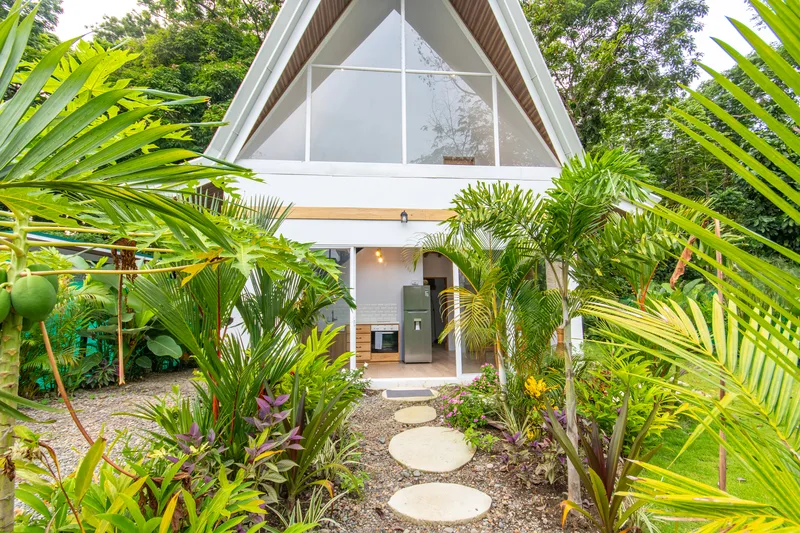
- Transportation from Crystal Jungle Villa: The villa has secure gated parking for day trips to all the trailheads. Bikes are available to rent in Puerto Viejo town for $10–15 USD per day, which handles the Manzanillo road and Cahuita easily.
FAQ
What is the easiest hike near Puerto Viejo?
The Gandoca-Manzanillo coastal trail is the most accessible option. It's flat throughout, free to enter, and requires no guide. A 2 km out-and-back from Manzanillo village is easy for any fitness level and typically takes under an hour. Howler monkeys and iguanas are common within the first 500 meters.
Can you hike the Manzanillo trail without a guide?
Yes. The Gandoca-Manzanillo trail is open to independent hikers with no permit or guide required. The main path is easy to follow. A local guide is optional—but if wildlife is important to you, it's worth the $20–40 USD. A good guide will spot animals in 30 minutes that you'd miss in two hours on your own.
How long does the Cahuita National Park trail take?
The full 8 km round trip takes 3–4 hours at a relaxed pace with wildlife stops. If you're short on time, a 2–3 km out-and-back from the Kelly Creek entrance takes about 1.5 hours and still delivers the sloths, monkeys, and beach that make Cahuita worth the 30-minute drive north from Puerto Viejo.
Do I need a guide for waterfall hikes near Puerto Viejo?
Yes—the waterfall trails are on private land, unmarked on any public map, and change seasonally. You cannot do them independently. Book through ATEC or Terraventuras in Puerto Viejo town. Both organizations have been operating these tours for years and their guides know the routes well.
Related guides
- Wildlife in Puerto Viejo — sloths, monkeys, toucans and where to spot them
- Cahuita National Park day trip — the best coastal trail near Puerto Viejo
- Manzanillo Wildlife Refuge day trip — jungle trails at the south end
- Best time to visit Puerto Viejo — month-by-month weather guide
- Puerto Viejo itinerary — 3, 5 & 7-day plans
- Getting to Puerto Viejo from San José — bus, shuttle & driving options